

Right now, somewhere, a person with a legal problem is filling out a contact form on a law firm website. Anxious. Ready to act. And almost certainly filling out two or three other forms in the same sitting. Whoever calls back first usually wins. Everyone else inherits a lead that already made up its mind.
This is the part of getting clients that gets the least attention and decides the most. Marketing spends money to make the phone ring. Intake is what turns that ring into a signed matter, or into a voicemail nobody returns. And the window? Smaller than most firm owners think.
Why an AI Legal Intake Agent Helps Law Firms Respond Within 5 Minutes
The number everyone cites comes from a study Dr. James Oldroyd ran with MIT and InsideSales.com. More than 15,000 leads. Over 100,000 dial attempts. What they found: reaching a lead inside 5 minutes instead of 30 made a company roughly 21 times more likely to qualify it. Waiting wasn't a small tax. It was the line between a real conversation and a dead end.
The speed-to-lead numbers, plainly:
• Contact within 5 minutes vs 30 minutes: about 21x more likely to qualify the lead
• Same comparison: about 100x more likely to reach the person at all
• Law firms that respond to online leads in under 5 minutes: 25%
• Law firms that never respond to an online lead: 26%
Read those last two again. A quarter answer fast. A quarter never answer. Everybody else is stuck in the middle, calling back hours later, by which point the client is already on the phone with someone else.
That gap is the whole opportunity. Most of your competitors are either slow or silent. An AI legal intake agent — think of it as an always-on AI receptionist for the firm — closes the gap by answering the second an inquiry lands, day or night, before a human is even involved.
Why Fast Legal Client Intake Increases Conversions
The pressure isn't only competitive. It's what people now expect. Recent intake research shows nearly 8 in 10 legal consumers expect a reply within 24 hours of reaching out. Sounds generous, until you put it next to the 5-minute math. Hit the 24-hour mark and you're not competing on service anymore. You're competing for whatever's left over.
There's a quieter trend buried in the data too. The share of firms responding within 5 minutes went from 13% in 2021 to 25% more recently. Fast is becoming the baseline. The firms speeding up are pulling work away from the ones that aren't, and that gap widens a little every month.
So faster legal client intake doesn't just feel better. It converts better. Same leads, same ad spend, more signed matters, because you got there first.
Why Small Firms Lose the Race
None of this is a secret. Firm owners know they're supposed to call back fast. The problem is structural, not a motivation thing.
Here's where the leads actually go:
1. The attorney is in court, in a deposition, or with a client, and just can't pick up.
2. The lead comes in at 7pm, on a Saturday, over a holiday, when nobody's watching the inbox.
3. Intake is bolted on top of a full caseload, so the person supposed to answer is already doing three other jobs.
4. Web form submissions drop into an inbox that gets checked twice a day. Not twice an hour.
And this is the part that stings. The 2026 Clio Legal Trends data found that 71% of solo practitioners and 75% of small firms now use AI in some form — yet only about a third of each group say it actually lifted revenue. So the tech is already in the building. It's just not pointed at the moment that decides the sale. Law firm intake automation only pays off when you aim it at intake, not at some side task.
What Winning the 5-Minute Window Actually Looks Like
The fix isn't "try harder." It's getting yourself out of the way as the bottleneck. Firms that hit the window consistently tend to share a few habits.
• Every new inquiry gets an instant first touch, day or night, before a human is involved.
• That first touch does real work — it runs AI lead qualification, checks for conflicts, and books the consult, instead of just saying "we'll get back to you."
• Nothing hinges on one person being free. Coverage keeps running while the attorney is in court, asleep, or on a beach somewhere.
• Every lead lands in one place with its details captured, so the follow-up never slips through a crack.
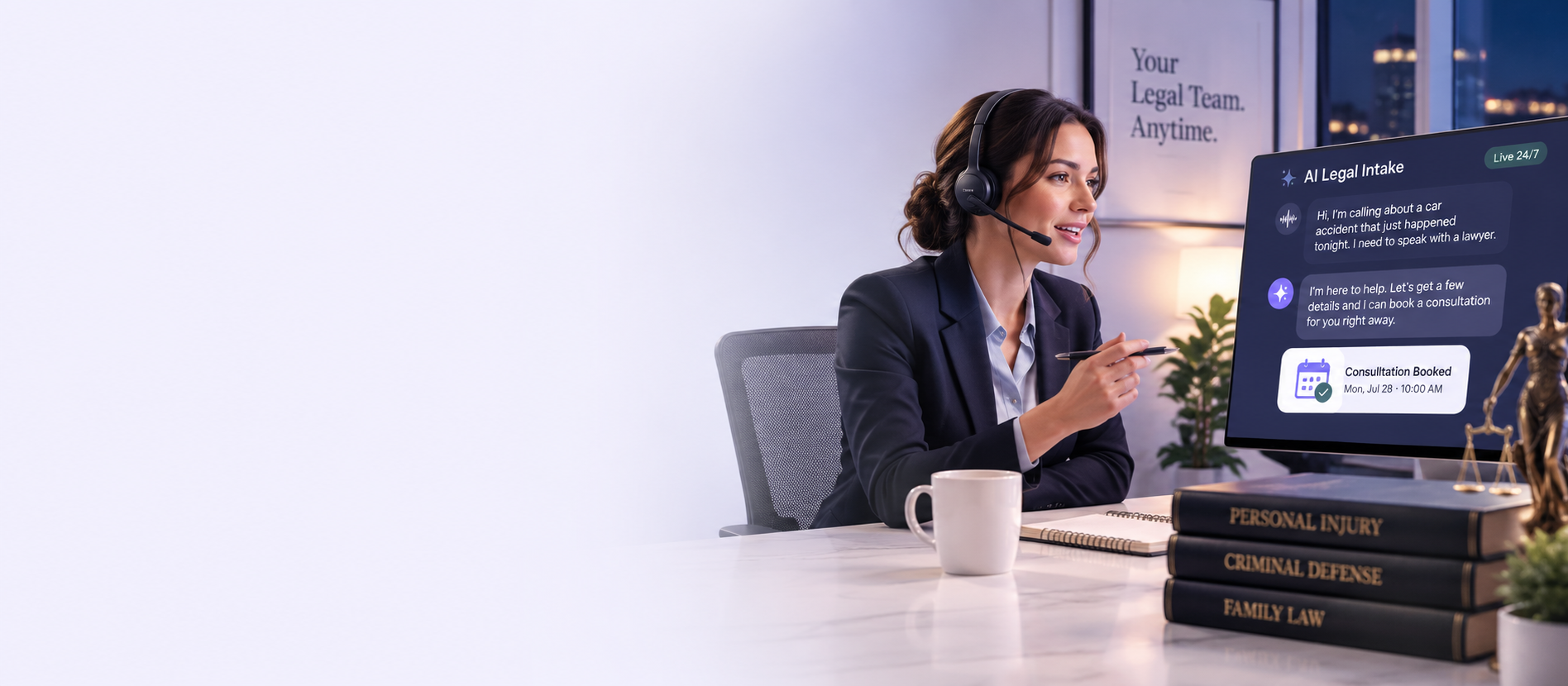
That list is basically the job description of an automated legal intake system. A virtual intake assistant answers in seconds at any hour, asks your qualifying questions, screens out the matters you don't take, handles the legal consultation scheduling for the ones you do, and hands the attorney a clean file instead of a missed call. The attorney still owns the relationship and every piece of legal judgment. The machine just makes sure the client is still there when the attorney picks up.
None of this replaces the lawyer. It replaces the silence. A good legal intake workflow runs quietly in the background — automated legal intake catching the inquiries that used to die in an unwatched inbox, then routing the good ones to a human.
The firms winning intake in 2026 aren't the ones with the prettiest brochure. They're the ones that answer first. The 5-minute window is open right now, on your own site. Only real question is whether anyone's there to catch it.




.svg)